

I came back from the Emergent Ventures ‘unconference’ earlier this week, and I am so pumped up! It’s crazy to be in a space full of people who obsess over the problems they care about, pour their time and energy into it with optimism (and a pinch of obstinacy), overcome obstacles that block their path, and always always want to help each other out; it reinforces my faith in the ability of the human race to ‘just do things’.
The last few weeks have been crazy.
1. I represented BioCompute at the MolecularArxiv Autumn School, and presented our first ever poster at an academic gathering (thanks, Jacki for helping out with the poster).
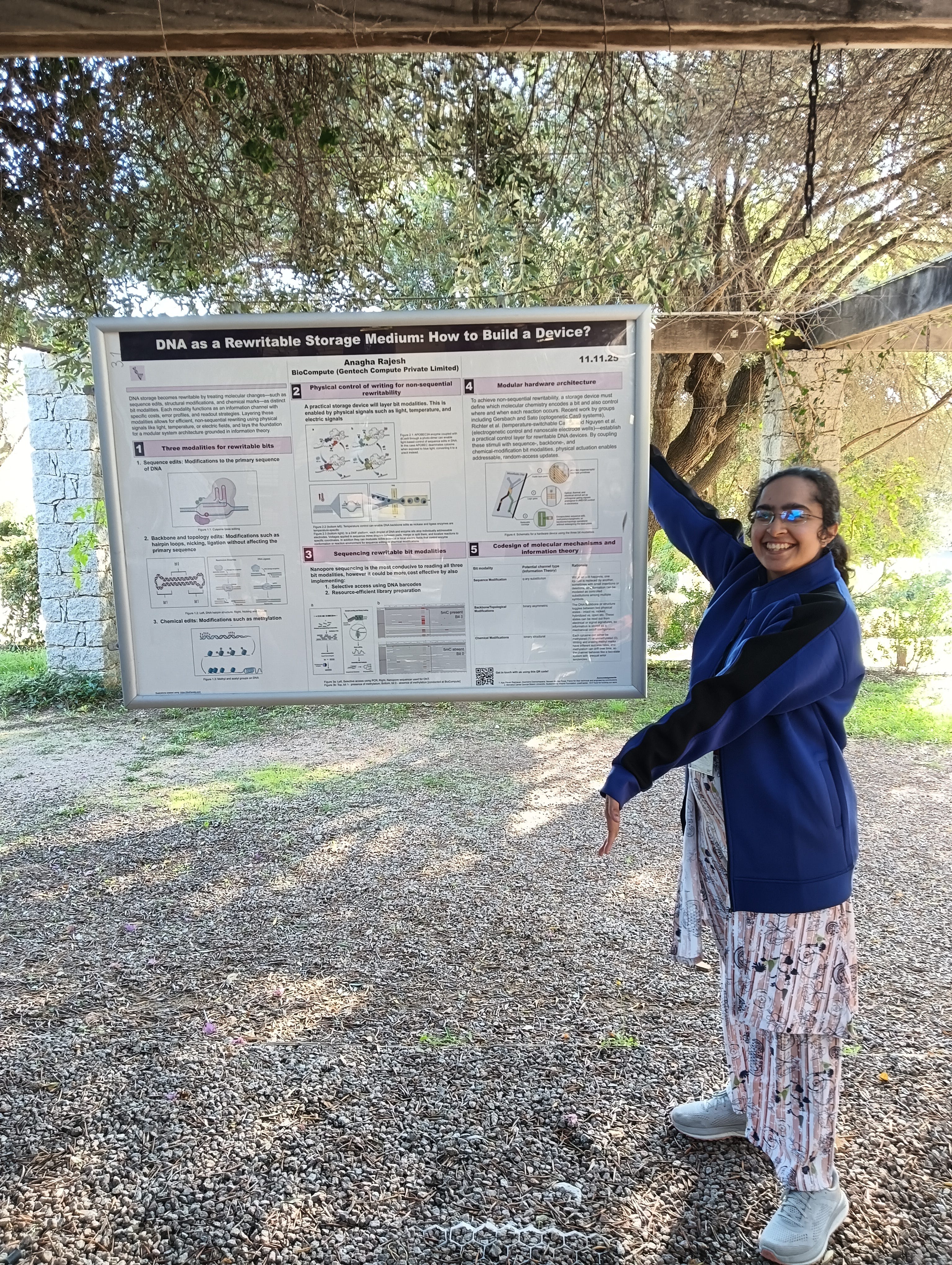
Image Description: Poster presentation, yes it was outdoors
Hosted in a hamlet in Corsica (an island in the South of France where Napoleon Bonaparte was born and raised), the autumn school brought together some of the smartest folks in DNA data storage for five days. Discussions and debates flowed against the backdrop of the scenic bay surrounding the Research Institute Scientists De Cargèse, a space started by particle physicist Maurice Levy to enable scientists to get away from labs and classrooms, and rediscover the joy of chatting about science in a friendly setting. Being locked in an island (with limited access to the internet, and unlimited access to starry skies) got everyone to shed the formality of traditional academic conferences and bond over fun stuff like teaching and learning languages in the community kitchen (Thanks Keshav for keeping me well fed with Indian food xD).


We are in talks to kick start a few collaborations with folks I met in Cargese, more on that soon!
I also spent a week in Paris meeting with academic labs at Sorbonne (that’s where our competitor Biomemory started), ESPCI and the Curie Institute.
2. Automation
We have automated our encoding pipeline, using our automated liquid handler and some scripts. This is a fancy way of saying you can enter any text data that you want to store, and you will have a robotic system programmed to figure out which edits to make to DNA and actually do them.
Now we are zooming into scale up mode. We are soon going to be the first folks to store TB scales of data in DNA (at reasonable unit economics), fingers crossed.
We are now designing accelerated aging studies to test how long the data stored in DNA can last without degradation (P.S. it’s a few hundred years but we are attempting to get to the exact number) so that we can enable many of you to store data that matters to you for your future generations.